Showing posts with label counting carbs. Show all posts

Bolus Less


There are a few foods consumed around here for which the official carb count just doesn't work. Maybe the packaging is wrong? Maybe my daughter's metabolism is just way different for a few specific foods? We've decided it's more important to get the bolus right than to figure out why it happens.

Foods in our regular rotation for which we've learned to adjust from standard carb counts include blueberries, for which she needs barely a hint of insulin, and a specific brand of frozen tortellini, which is probably poorly labeled. 

Then there are other foods which we have to periodically relearn, like the Italian ice at our favorite ice cream store, which is significantly lower-carb than the Calorie King app's 'average Italian ice' measurement. This was the first spring we remembered a reasonable estimate and guessed well enough that we didn't have a long, low night.

Ever in search of non-dairy options, I recently picked up a boxed macaroni and cheese for my daughter to try.

The package said that the mac and cheese had 50-something carbs per prepared cup. Which seemed high to me, but I thought that whatever made up the 'cheddar flavor' part was, perhaps, super-carby. 

It was not. Or my daughter's system did not perceive it as such. Over the course of the following two hours, she consumed 30 carbs to bring up the ensuing low blood sugar. 

She liked it so it's a keeper. But it's not something that's going to be in the regular rotation. She'll have it after holidays, when there's leftover ham in the house (because mac and cheese with ham is a family favorite), or once in a blue moon as a quick fix meal out of the pantry for an unexpectedly hectic night.

The lingering question was, how are we going to remember to give less insulin for this next time, which could be months from now? By posting the product label on the inside of the pantry with "Bolus Less!" scrawled across it in sharpie. 


Too Much Trouble

 
I wanted a loaf of the homemade bread.
 
Probably the apple crumb, but there was also a blueberry strudel one.
 
I looked them over, picked them up, read about where they were made.
 
They were rather expensive, but they looked amazing.
 
I imagined having a slice with my coffee the next morning, or maybe for dessert that very night with tea.
 
If I bought it, though, I would have to share it.
 
Then I'd have to help figure out how many carbs were in it.
 
I'd have to wonder all night, or all morning, whether I'd guessed right.
 
I might be up giving juice at 2 a.m., or distracted every few minutes by Dexcom alerts all morning.
Chances are the bread would be good enough that my daughter would want another slice.
 
The whole guess/wonder/deal with the outcome process would begin again.
 
We'd already had cider donuts as an afternoon treat. We'd all enjoyed random but delicious treats the night before at a marching band event.
 
I was tired of guessing carbs and dealing with the aftermath.
 
I did not bring home any bread.
 
It was too much trouble.
 

Serving Size

Thanks, Peeps, for making my daughter laugh
when she counted her Easter treat carbs.


She'll Have The Usual


Eating out usually involves much angst about how many carbs there are on the plate and about how much of the meal will be consumed.  And therefore about how much insulin should be given before or (lets be realistic here) as the food starts to be eaten.

We've started to play 'guess the carbs' together most times we eat out. My daughter figures out a number first, then I add my input and we discuss.  At several recent restaurant meals she's guessed between 40 and 50 every time.

When it's been my turn to give input, I've eyeballed the plate and said something like, "If you the eat 2 pieces of the battered fish and about 20 of those fries, it's probably around 50." 

Or at the Thai place, "You think you'll eat around half of that bowl of pineapple fried rice?  Maybe about 50."

Or at the diner, "Three blueberry pancakes?  Probably 50."

Fifty.

It's the going rate.  Sometimes we add a few at the end if the fries are irresistible or the pancakes arrive heavily dusted in powdered sugar.  Sometimes we'll ease down into the low 40's if the fried rice is skimpy on the pineapple or if she's not as hungry as usual. 

But lately we've been starting at 50 and adjusting from there.  It's nothing more than a mental math trick, really, but I find looking at the food and asking, 'is this about 50?'  somehow much less stressful than starting from zero and trying to add up the plate.  There is, of course, always a generous margin of error in figuring restaurant carbs.  And this method doesn't work when she orders a big salad for dinner. 

But if we're going to eat out, we need to start somewhere. For now, we've decided to start at 50.

Food: It's What's for Eating


An 8 year old relative of a friend of mine was recently diagnosed with type 1 diabetes.  A couple of weeks post-diagnosis, my friend e-mailed saying that the family is really struggling with what to feed him.  He was previously very much a junk-food fan.  What ideas and advice did I have?

My initial e-mail response was lengthy and probably a little confusing.  It's such a complicated and loaded question.

My first response was to look for good articles and posts on my favorite blogs and websites.  After twenty minutes of that, I found twenty different ideas of how best to eat with diabetes.  No wonder they and so many other newly-diagnosed families are confused. 

I imagine the hospital team sent them home with a meal planning guide and some hand-outs about carbohydrate counting and the value of consuming protein and carbs together.  He's on injections for now, so limiting the injections is part of meal planning too.  But he's 8.  And everything's different.  And he'd probably really like a big stack of pringles and a snickers bar.

So here's what I said in a nutshell, hopefully more well-thought out this time (I'll be sure to get them the link to this post):

1. If nothing else, count the carbs.  Learn how to read the labels, learn the carb ratio, learn the math and give the insulin.  A snickers bar is not an apple.  French fries aren't steamed brown rice.  But if you give the right amount of insulin for them, his blood sugar won't spike astronomically and you'll be learning and practicing the carb counting skills which will be the basis of diabetes care for the foreseeable future.

2. Rome wasn't built in a day.  Protein plus carbs is great.  The combination streamlines the blood sugar levels.  Vegetables, fruits, whole grains and low-fat proteins are important too.  Foods with fiber affect the blood sugar less than straight white bread.  BUT eating is great too, and sometimes compromise is necessary.  I had a child who ate nothing but cold cereal, milk, chicken nuggets, goldfish crackers, baby carrots, sugar free jello jigglers and animal crackers for several months of her toddlerhood.  She lived to tell the tale.  Not only that, but this weekend she ate Moroccan spiced chicken stew with whole wheat couscous on Saturday night and roast salmon, salad with balsamic dressing and a brown rice medley on Sunday night.  We actively chose (after a few weeks of frustration) not to force the food issue when she was 2.  Now she's a good healthy eater, because that's the way her parents eat and she slowly learned that a variety of foods are delicious. 

3. Dessert is okay.  We never stopped having treats.  One cookie instead of 3?  Yes.  Parsing out the Halloween candy over a couple of weeks.  Absolutely.  She had animal crackers and a glass of milk most nights until she was 5 or so.  Eventually, other cookies, frozen treats and brownies began to be included in the mix.  Holiday pies and birthday cakes have never been forbidden.  As a result, (I think) I have a kid who has rarely snuck extra treats or cried because she was left out of a celebration. 

Should this newly diagnosed kid be eating a scrambled egg wrap for breakfast, bean soup for lunch and a plate with 2 veggies, lean protein and whole grains for dinner?  Probably.  Should his primary treat be roasted almonds?  Yup.  But he's 8.  And his world just turned upside down.  And no kid or adult really eats like that anyway (well- very few, and they're probably not the happiest people). 

In the real world, balance is necessary. This newly diagnosed kid should be eating the healthiest combination of foods he's willing to eat on a daily basis.  He should be learning about good nutrition from his family, his healthcare team, and others who care about him.  He should be learning to read a nutrition label with help from adults, so that he can take the right amount of insulin for whatever he eats.  He should be learning about low carb and carb-free snacks he can eat when he's hungry but doesn't want to take an injection.  Meanwhile, his favorite foods should remain available and he and his family should learn how to cover the carbs in them. And he should have the occasional junk food if he wants it.  Having diabetes is hard enough as it is.

Kohlenhydrate


A friend returned from a week visiting family in Germany with these delicious treats as a souvenir for my daughter.

If each piece weighs 16.76 grams and a serving is 100 grams and each 100 grams has 53 grams of kohlenhydrate, then how many grams of kohlenhydrate does one piece have?

These treats appeared in time for lunch at the nurse-free summer music program my daughter attends.  She valiantly tried to figure out how many carbs each one contained but kept coming up with unreasonable sounding answers.  "So I ate one and guessed."

Who could blame her?  It's hard enough sometimes to sort out carbs on an American and english-language nutrition label.  Figuring this one out could significantly cut into a person's chocolate enjoyment.


What Did I Miss?

Today, we'll look back 2 years to a pool party for all girl scouts from our area.  As troop leader, I was there, in charge of feeding and keeping track of my group of fifth grade girls. 

This was our first pool visit of the season.  My daughter disconnected her pump and got in with her friends.  They then got out and opened a couple of bags of chips.  "Can I?"  "Just a few."  We'd delivered  a correction bolus for a 200-ish number on the way to the pool.  With the exercise, I figured a couple of chips couldn't be too bad.  Plus, to be honest, it seemed like such a 'normal kid' thing to sit on a circle on beach towels with your 11 year old friends, talking, braiding each other's hair, and muching on chips.

After another swim, the pizza arrived.  I did (to my credit) remind her to plug her pump back in and check.  230.  I juggled the meter-remote, paper plates for all the girls, opening the grapes and watermelon, pointing out the drink cooler and providing napkins.  I bolused for pizza and watermelon.  I might have added the bg.

She ate, unplugged, and headed for the water slide.  An hour later they came back for dessert.  A cupcake and 2 mini girl scout cookies.  She was already partway through the cupcake when I realized she hadn't checked again.  She was reading the box for the cookies (reclaiming a bit of good will).  "4 each, mom."  I had made the cupcakes, so had a number in my head for those.  Still juggling dessert requests and napkins, I bolused.   I glanced over.  She had no pump attached.  She plugged in and we bolused again.

Half an hour later, she found me talking with a mom on the other side of the pool.  A friend's sister's troop and given our troop mini fire cracker pops.  Could she eat hers (which she was holding, open, in her hand)?  From the cobwebs of my brain came the knowledge that these were 'only' 9 carbs.  I gave the o.k.  She was standing there with her friends, on the way to the shuffleboard court.  She bolused for it when she got back to the table.

Once we'd packed up and gotten in the car, her blood sugar was around the 250 mark.  She corrected and had some water when she got home.  An hour later, still 250.   Obviously, the whole evening was riddled with diabetes mis-steps.  Chips with no insulin (probably more than a few), not accounting for missed insulin in the pool, a dinner diet of pizza, chips, watermelon, cupcakes, cookies and popsicles. Everything was bolused for on the fly, often after the food was partially consumed.

Yet, you diabetes detectives out there, there's one more big reason that high number didn't come down. 

Anybody guess it?

I had bolused for dessert while the pump was detached.  Then again when it was.  The pump included all of that insulin in the insulin on board total.  So when we went to correct the 250 after the party, it gave very little, assuming a whole extra cupcake and 2 cookie's worth of insulin was still hanging around.

Any 'party by the pool' event is a challenge, diabetes-wise.  The level of difficulty rises exponentially if I'm in charge of more people than my own kid.  In the end, it was a fun evening and the 250 came down quickly once I'd realized the error of my ways.  But keeping track of diabetes at this kind of event is a full-time job.


Birthday Day and Other Heavy Eating Occasions


My daughter's friend had a birthday last week.  It was on the same day as mine.  The kids have found a way to skirt the school nutrition policy of 'no outside food for celebrations' by bringing in treats to share at lunch. So lunch that day included oreos, hershey kisses, doritos and munchkins.  To her credit, she ate the sandwich and grapes I packed first, but she sampled the rest as well.

For dinner we went to a Thai restaurant and she had an uncountable portion of pineapple fried rice. We came home and had mini cupcakes and cannolis for dessert.

Our household diabetes philosophy (yours may vary) allows sweets, and even junk food.  Birthdays include cake.  S'mores over the fire pit or a trip for italian ice are part of summer fun.  A little bag of chips for the walk home is o.k.  Most days include cookies or a non-dairy frozen treat before bed. Taken one at a time, or even two in one day, we're o.k. with both the questionable nutrition of it and with the diabetes challenges.

'Everything in moderation' is the general idea. But on days when moderation goes out the window, I'm left feeling torn.  Should we ever let her eat this way?

"Yes!  You can eat anything except poison...or cookies made with poison..." is one side of the coin. But she really can't eat anything and maintain the same kind of blood sugar numbers she does when she eats healthy, countable things.  Twenty carbs of oreos and doritos is not the same as twenty grapes. Half a restaurant portion of pineapple fried rice and a bakery cupcake simply can't be counted and dosed for as accurately as portions prepared, weighed and measured at home. Add the 'one more dorito because everyone else is still eating,' or the picking all the pineapple out of the fried rice despite bringing home 'half,' and the challenge increases.

Still, I lean towards letting her learn from her mistakes over outright forbidding her from eating like this. She'll encounter days with heavy eating potential for the rest of her life, so perhaps helping her develop a healthy sense of how to handle them is the answer.  Last week's birthday day was an example of how not to handle it.  And she knew it.  She was upset that her blood sugar was high for hours.  Between that lengthy high and the general junk food overload, she had some lingering indigestion into the next day.

Sometimes she makes better choices.  Last weekend, she said no to lunch out with a friend before an evening birthday party because it would consist of too much uncountable food in one day.  She's come home from parties and told us she was the only one who ate the proffered grapes or salad to balance out the junk. She will report with alarm how many cookies or cupcakes some kids consume in one sitting.

I guess it's like all things diabetes, really.  We do our best.  We try to fit the diabetes stuff into what we consider a normal, healthy lifestyle.  We try not to let it ruin our fun.  We learn from our mistakes.  And we're never quite sure we're doing it right.


Snack Time


I hear a lot about teenage boys.  They're always hungry.  You can't keep anything in the house.  Buy out the snack aisle before you even consider inviting their friends over.

What nobody every clued me in to was that the same is apparently also true of teenage girls.  Maybe it doesn't last as long, or maybe I'm encountering a particularly hungry bunch.  But these kids are ravenous.

A bunch of friends came over on a recent half day.  Each one had bought a sandwich or a bagel at one of a couple of eateries on the way home from school.  They sat around our dining room table and ate them. Completely.  It wasn't long ago that I'd have 6 girls here for lunch and there'd be half bagels, large portions of sandwiches or the bulk of the pizza I'd ordered leftover.  On this day, there were napkins and crumbs.

Half an hour later my daughter emerged from the basement playroom (hang out room? rec room?  what do we call it now?).  "I'm bringing down the popcorn chips."

Within half an hour she returned with a bowl containing only a hint of popcorn dust and absconded with over a pound of grapes.

Pretzels were next, enough to fill a large sized salad bowl.  Crumbs and salt covered the bottom half an hour later when it was returned for a refill, and again when it was cleaned up as the girls went home.  Presumably they, like my kid, proceeded to eat full dinners and ask for dessert.

The whole experience felt like a cross between feeding cookie monster and a pack of wolves.  Food disappeared instantaneously.   Crumbs and dust were left in the wake.

The diabetes link in this post, you ask?  It's a challenge to bolus for this kind of grazing.  Up to a year or so ago, I just didn't allow it except at the occasional party.  Snack time involved a bowl, careful counting or measuring cups, and a nice solid bolus.  And on a regular basis, that is still the preferred procedure here.

Somehow, though, she managed to count and bolus enough of her snacks to end up with a very good blood sugar by the time her friends went home and she started asking what was for dinner.


The Buffet Table


Personally, I love a good appetizer and snack focused buffet table.  Interesting dips, meatballs, crackers with good cheese and foods encased in puff pastry are a few of my favorite things.  Top it off with a good cookie table and it's perfect.  If I'm there alone.

With my daughter around, a couple of hours of happy grazing turns into a couple of hours of math and negotiating.

When there is a buffet table, one is expected to graze.  You have a mini hot dog, meet the relative in from out of town, try a couple of dips, chat about the school play, make your way to the meatballs where you spend time with the party host; and on it goes.

The first problem with this scenario is that each snack requires a math problem and a bolus.  When every conversation is interrupted with 'I took 4 meatballs, mom,' or 'I just ate 7 corn chips,' it's hard to carry on a conversation. When I'm interrupted to nix the plea for a 4th cookie, my already limited cocktail party-related social skills take a big hit.

The second, but related problem is an extension of the standard regular-people buffet party challenge.  If I have a drink in one hand and a little plate in another, I already must find a third hand to eat.  Add the meter remote to that third hand and I'm out.  Even with the understanding that every mother develops a third hand (a.k.a. the ability to juggle well), this scenario becomes impossible and I remain hungry or thirsty so that my kid doesn't end up high.

So a buffet party turns into me with a drink OR food in one hand, following my kid with the meter remote while trying to make small talk and perform carbohydrate equations in my head at the same time.

Ironically, I suppose, we throw one of these parties every year.  The difference is that I painstakingly create a list of every food with its carbohydrate content and post it on the fridge.  My daughter takes the meter remote and is able to do her own juggling act while I play hostess and eat my fair share of mini quiches.

In a perfect world, we'd be handed a cheat sheet at the start of every party, and one of these cool plates .


Um...Yuck?


"The granola is 10, the blueberries are about 5.  That was the new brand of soy yogurt.  How many carbs were in the container?"

As I turned around from giving the smoothie one last whirl, I found my daughter elbow deep in the kitchen trash.  Holding the yogurt cup delicately with 2 fingers, she said, "27" before dropping it back in and turning to wash her hands.

It wasn't the first time this scene has played out here.  Generally, though, I'm the dedicated trash picker. What particularly struck me about yesterday's episode was my child's nonchalance about diving in herself.

Add it to the long list of peculiarly unpleasant things we do for diabetes' sake.

We pick the trash.


Time Suck


A sampling of annoying events from the past few summer days:

I received a lunchtime phone call from the beloved nurse-free music program.  "I'm 72.  How should I bolus?"  The question took several minutes to sort out.

While at the pool, she had to stop to disconnect or reconnect her pump while her friends were already running for the diving boards/ping-pong table/snack bar.  This scene repeats several times daily.

She had to leave her friends in the pool to treat a low blood sugar.

We delayed leaving for the pool to replace the tape on the Dexcom.

We delayed leaving for music to add tape to the Dexcom.

I spent half an hour online searching for tips to keep the Dexcom stuck when frequently submerged in a swimming pool, lake or ocean.  (Suggestions are still welcome...).

We expected to do a quick site change, only to find that the pump battery needed to be replaced and the supply of wipes needed to be replenished from the downstairs closet.

A desire for a summer peach turned into an ordeal involving the food scale and the calorie king app since it was the first peach of the season and we couldn't remember the carbs.

A group of friends descended on the kitchen for a snack break.  She was the last to eat, as usual, since she had to stop to check her blood sugar, read the nutrition label, and bolus for her food.

A cure and/or a bionic pancreas will some day dramatically improve my daughter's health.  That, in the big picture, is the reason we want these things.

The other benefits are indisputable though.  When the day comes, we'll go through every day without any of these kinds of stops and detours.  She'll stop being the one lagging behind at the pool.  She'll dive into her friend's pantry right along with everyone else.  Diabetes won't delay the fun.  We can't wait.


Armed (and Dangerous?)


The birthday party challenges keep coming this spring.  The latest was an invitation to a celebration at a restaurant serving a buffet brunch.  Mulling it over, I shared the invite with my daughter, offering her an alternative option. If she didn't want to manage the diabetes aspects of a buffet brunch alone, she could join the group after brunch for the pool party which would round out the afternoon.

"I really think I can do it!" was the overwhelmingly self-confident response.

What could I say?

What was the worst that could happen?

How would we ever get to an overnight road trip with friends without first allowing smaller steps like this one?

So she went to a very nice restaurant with beautiful water views to have brunch with a few of her friends and two brave parents.  Armed with her pump, dexcom, cell phone and calorie king app, she was otherwise on her own.

After a two mimosa brunch of my own and a comforting mid-afternoon ice cream stand stop, I picked her up at the pool at 5:45.  She was smiling from ear to ear and recounted in great detail all of the food she'd enjoyed.  She loved the restaurant, being with her friends, and playing volleyball at the pool.

Diabetes-wise? The Dexcom graph included dots on almost every level of its screen.  By 6 it just read 'high,' and stayed that way for over an hour despite two major corrections. The meter's remote showed that over 100 grams of carbs had been bolused for at brunch, and that corrections had been given at 2 and 4 for numbers in the 150-200 range.  She had unplugged the pump twice to swim but not for long since the water was "freezing."

As far as I can tell, she did all that she could, and I made sure she understood that.  A discussion of the desserts she sampled leads me to believe she under-calculated their carbs but since miniature pastries aren't on our regular menu, she was forced to guess.  The real problems didn't start until almost 4 hours after brunch, probably when the fat from the {still unclear to me number of} pieces of bacon she ate met the 105 + brunch carbs and the handful of pretzels she bolused for at the pool.  Truth is, she could easily have hit 400 whether I was with her or not.  Buffets are hard.  Mystery foods are hard.  Add into the mix frigid pool water which tends to spike her, unplugging to swim, and a healthy amount of excitement, and the results are not entirely unexpected.

All we can do is try to learn from the experience.  Mini pastries have more carbs than expected and should be consumed in limited quantities.  Balancing high carb and fatty foods from the buffet with a few lighter options might mitigate disastrous blood sugar results.  Following a heavy meal with an adrenaline-producing dip in ice water while the pump is unplugged shouldn't be a regular occurance.

You may think it was dangerous to send a 12 year old with diabetes to navigate a buffet brunch.  Perhaps a little bit.  But really, on some level, it's dangerous to send a 12 year old with diabetes anywhere.  The best I can do is to arm her with the tools and knowledge she needs to take care of herself, and with confidence. Despite the results, this was definitely a confidence-building experience.  For both of us.

Relentless


We're going through a stretch of very active diabetes management here, and it's exhausting.

Don't get me wrong.  We're always managing diabetes; all day, every day.  It's just that sometimes it fades into the background a little bit.  This isn't one of those times.

At February's appointment we were surprised by a creep up in my daughter's A1C.  Nothing dramatic, mind you, but worth working on.

Suggestions to address this problem were discussed at our appointment, and we implemented them right away.  Then she started eating.  Everything.  She's growing noticeably taller by the week.  At every appointment lately, the endocrinologist has reminded us that her total daily dose of insulin is likely to double in the next couple of years.  At this rate it'll double by the time we see him again in May.

Her basal rates and insulin to carb ratios are going up and up. With these changes come increased finger sticks and dexcom alarms, the return of the log sheets, and an extraordinary amount of thinking.

I'm trying to meal plan and grocery shop more carefully too.  Countable carbs and balanced meals are important so that we know if the insulin changes we're making are right.  The fewer variables in that equation the better.  I'm also trying to fill her up, so that she's not looking for a snack an hour after dinner. If she does want a snack, I want to have healthy, filling choices on hand.

I'm hearing from the nurse's office at least once a day for a high or a low.  Then she's at play practice until five or six o'clock most days after school, so we're managing snacks and dance induced lows via text all afternoon. Meanwhile we're spending time figuring out how to include her diabetes equipment in her play costume. But who doesn't love a challenge?

The sedentary lifestyle of winter is giving way to the activity of spring.  Yesterday was the first outdoor recess since November. She's walking home again when she doesn't have play practice.  Schedule changes and field trips are creeping back into the school days.  So are juice boxes.

Factor in what feels like more than our fair share of diabetes flukes like the other night's 2 a.m. site change, and it feels like it's all diabetes, all the time here.

Which it is.


Measuring The Rice


A household favorite weeknight dinner this a one-pot teriaki dish.  The recipe is on the back of the Minute Brown Rice box if you're interested.


I love the ease of making and cleaning up this meal, which is ready in 20 minutes and, true to its name, uses only one pot.  The odd yellow color is a feature of amateur photography, not of the dish itself.

The trouble with this dinner is with the serving of it.  Since the carbs are primarily in the rice, but in the end all of the ingredients are mixed together, serving my daughter's portion takes some time.


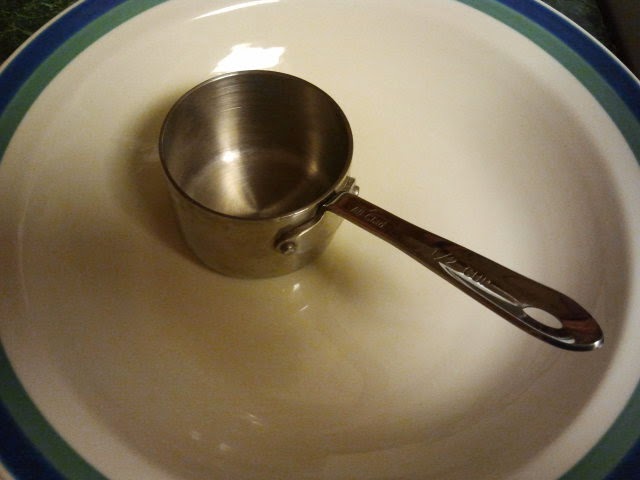
First, I find a half cup measuring cup since that's about how much rice she eats.


Then I push stuff around in the pot, attempting to separate enough rice from the other ingredients.


Finally, a half a cup.


Now to add the rest of the ingredients and toss it all back together so it looks like everyone else's.

Every day there are many weighty reasons I wish for a cure for diabetes.  But I must say I won't miss these little annoyances one bit.

Meal Plan


When my daughter was first diagnosed with diabetes she had a very strict meal plan.  It specified exact portion sizes of starch, fruit, milk, protein and vegetables for all 6 meals and snacks every day.  Getting particular servings of particular foods into a toddler was, as I've explained before, awful.  But this was during the dark ages of NPH insulin. To avoid dangerous low blood sugars it had to be done.

Fast forward 11 years.   My daughter has an insulin pump and the flexibility to vary her carbohydrate intake from day to day.  Yet, as we were reminded this week, sticking to a general food routine has its benefits.

The installation of braces has altered the meal plan at our house.  Smoothies, soups, applesauce and hot cereals have replaced many more standard meals in the past week or so. We've learned that, for my daughter at least (everybody's diabetes is different!), protein is important.

The vegetable soup with just a few chick peas was soft and delicious.  The resulting low blood sugar necessitated 10 p.m. juice.  To make things worse, the juice had to be sucked down through the orthodontic head gear, challenging at any time but particularly when half asleep.

The lunch of coconut milk yogurt and applesauce went down easily.  But so did her blood sugar.

You physiology experts out there will already be aware that when we consume protein and carbohydrates together, the body digests the carbohydrates more slowly.  This slower rate of absorption stabilizes the blood sugar over a longer term.

For years now, with very few exceptions, my daughter's main meals have contained some combination of protein and carbohydrates.  Therefore her carbohydrate ratios and even likely her basal rates are contingent on both being in the digestion mix. Without protein, we saw quick drops in blood sugars after meals.  It was an interesting, if annoying, science experiment.

This week has been better.  She's chewing more easily.  The crock pot is in action, making things tender. The protein-free coconut yogurts have been replaced with protein-rich soy ones.  The scary post-meal drops have subsided.

The moral of the story is this:  Though we're told (and often loudly proclaim) that people with diabetes can eat anything they want as long as they bolus for it, we find that sticking with a general meal routine leads to more stable and safer blood sugars.

Of Braces and Smoothies and Math


What do you feed a growing 12 year old who's just gotten braces?

How about one with type 1 diabetes who can't have dairy?

Enter the single-serve blender, cartons of 'alternative milks,' coconut and soy yogurts, and a freezer full of frozen fruit.   And math.  Always math. The combinations are nearly infinite.  If your 12 year old gets hungry enough, she'll try them all. My daughter's favorite smoothie so far was today's.  It contained gently thawed mixed berries whirred together with half a blueberry soy yogurt, some granola and a little almond milk:


With 11 years of diabetes management under our belts, we've memorized the carbohydrate content of favorite breakfast cereals, breads, fruits and dinner items. Crackers, chips, desserts?  Filed away as well. It's become rare that we need to stop before bolusing to math out a plate (or glass) of food.  Sure, there's an occasional new recipe or brand.  Restaurants, and meals at which we're guests require some thought. Most days, though, armed with a measuring cup, a food scale, or the simple ability to count, we can move from serving to eating fairly quickly.

So this week's math intensive has been challenging.

The above smoothie required measuring frozen fruit, granola, soy yogurt and the accidentally purchased slightly sweetened almond milk. (The 'original unsweetened' kind blessedly has negligible carbs, making it unnecessary to measure.)Then there was the '1 cup contains x carbs, so half a cup would contain y carbs process for the fruit, granola and milk; add the half container of yogurt for a grand total of ???' word problem.


My daughter is enjoying experimenting with different smoothie combinations, which on one hand is fun.  On the other hand, I'm kind of hoping she decides this one's a keeper so I can take a math break tomorrow.

Big Numbers

I'm afraid of big numbers.

Like any person who manages or helps to manage diabetes, I'm afraid of big blood sugar numbers and big A1C numbers.  Every day is a battle to keep those under an acceptable threshold.  Yet those aren't the numbers to which I refer.

What I'm really afraid of are big carbohydrate numbers and big insulin bolus numbers.

My guess is that it all stems from having a child who was diagnosed as a baby.  She was 13 months old.  We diluted her insulin because we couldn't possibly measure the tiny amounts she needed with an ordinary syringe.  Her total daily dose was about 4 units.

She didn't eat much.  Breakfast was probably the biggest meal, carb-wise, coming in at a whopping 22 carbs.  She'd have a quarter cup of cheerios(8), half a small pear or half a jar of baby food fruit (8) and half a cup of milk (6).  Snacks were 8 grams, maybe 4 crackers or 25 goldfish.

To this day it gives me great pause to bolus for more than about 25 carbs. 

I vaguely remember mentioning this to a diabetes educator once, who kindly referred to it as a 'healthy fear of insulin.'  It's not all bad.  I'm not prone to over-bolusing and causing severe lows.

What I am prone to is under-bolusing.  The rational part of me weighs/measures/eyeballs the food and thinks '80 carbs.'  Then there's a little voice which says, 'but she never eats 80 carbs.'  Or 'how could that one dessert be 80 carbs?'

More and more often, I'm able to close my eyes, hold my breath, and deliver whatever crazy amount of insulin is called for.  An hour or two later, I'm glad I did.  Yet I never do it without trepidation.